
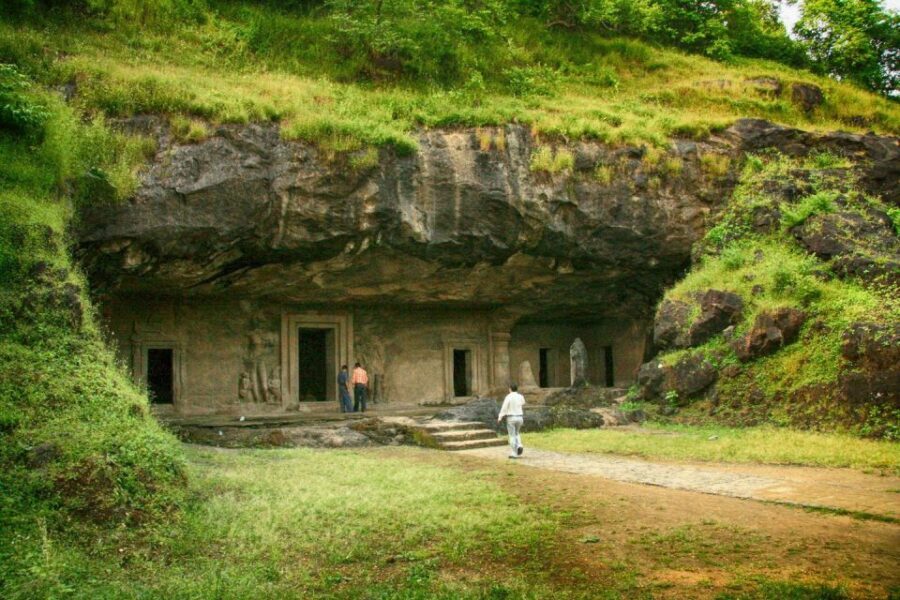
The Elephanta Caves are a UNESCO World Heritage Site carved roughly 1,500 years ago into a basalt hillside on Gharapuri Island, an hour by ferry from Mumbai’s Gateway of India. The main cave is 39 metres deep, its columns and three-headed Maheshmurti Shiva hewn directly out of living rock somewhere between the 5th and 7th centuries AD.
Reaching it is half the story — you queue for a ticket at the Gateway, board a rattling wooden passenger boat, cross Mumbai harbour past moored container ships, climb 120 shaded stone steps lined with souvenir stalls, and pay 600 rupees to enter what feels like an archaeological secret hiding in plain sight just off one of the most populous cities on earth.
This guide covers everything you need to pre-book an Elephanta tour that actually includes a guide (the carvings make no sense without one), the practical details of the ferry and the entrance fees, and the three best-reviewed tours from our database of Mumbai operators. We have used all three and ranked them by review count and rating.


- Quick Facts Before You Book
- Our Top 3 Elephanta Tours
- Elephanta Caves & Island Guided Private Tour
- Mumbai: Elephanta Caves Half-Day Guided Tour with Expert
- Private Elephanta Tour With Mumbai Sightseeing
- How to Get to Elephanta Island on Your Own
- At the jetty — the little train
- The 120 Steps: What to Expect
- Watch out for the monkeys
- What You Will Actually See: The Five Caves
- Cave 1 — the main temple
- Caves 2 to 5
- Costs: A Real Breakdown
- When to Go
- Elephanta and Your Wider India Itinerary
- Where to Stay Near the Ferry
- What to Pack
- Common Mistakes to Avoid
- Food and Drink on the Island
- Accessibility
- Final Thoughts
Quick Facts Before You Book
- Location: Gharapuri (Elephanta) Island, Mumbai Harbour — about 10 km east of the Gateway of India
- Opening hours: Tuesday to Sunday, 9:30am to 5:30pm. Closed Mondays
- Entry fee: 600 rupees for foreign visitors, 40 rupees for Indian and SAARC nationals, under-15s free
- Ferry fare: 180 rupees round-trip from Gateway of India, plus 10 rupees for the upper deck
- Ferry duration: Roughly 60 minutes each way
- Time needed on-site: Allow 3 to 4 hours door-to-door including the boat trip
- UNESCO status: Inscribed in 1987 for its rock-cut Shaivite temple art
Our Top 3 Elephanta Tours
These are the three highest-rated Elephanta tours in our database, picked from Mumbai operators with enough review volume to trust the ratings. All three include the ferry, the UNESCO entrance fee, and most importantly a real guide who can actually read the iconography in Cave 1.
Elephanta Caves & Island Guided Private Tour

This is the highest-review-count Elephanta tour in our database with 1,327 verified reviews and a perfect 5.0 star average. It runs as a private tour so you are not being herded around in a group of thirty, and the guide meets you at your Mumbai hotel before walking you through the Gateway of India ticket queues — which alone saves you about an hour on a busy day.
Once on the island the guide explains the nine principal bas-reliefs in Cave 1, points out which sculptures were damaged by Portuguese soldiers in the 16th century, and walks you over to Caves 2 through 5 for context even though most visitors skip them.
Budget around $42 per person depending on group size, and confirm pickup time at least 24 hours in advance. Runs every day the caves are open — which means Tuesday to Sunday only.
Mumbai: Elephanta Caves Half-Day Guided Tour with Expert
If you want a cheaper option and you are flexible on group size, this GetYourGuide half-day from Mumbai delivers the core experience at $30 per head with a 4.8 rating across 1,032 reviews. It is billed as 1.5 to 6 hours because the operator lets you choose how long you linger on the island — useful if you would rather skip the sweaty climb up Gun Hill and just sit in the shade near Cave 1. The guide is an Archaeological Survey of India certified expert.
Two things to know. First, the tour does not include the 600-rupee UNESCO entrance fee, so factor that in. Second, the small-group format means you might share the guide with up to 15 people, though most reported groups are closer to 6 to 8.

Private Elephanta Tour With Mumbai Sightseeing
This one is a full-day combo that pairs Elephanta with Mumbai sightseeing — a smart move if you only have one day in the city and want to see the Gateway, Dhobi Ghat, Marine Drive, and the Hanging Gardens alongside the caves. It is private with an air-conditioned vehicle included, which matters more than you would think in April-to-June humidity. The 389-review count is lower than the other two but the 5.0 rating across that sample is extremely consistent.
At $29 per person for a full day it is genuinely good value for two or three travellers. If you are solo, the private rate pushes higher, so check the price calculator before booking. Our Mumbai full-day sightseeing guide compares similar combo options if you are still deciding.
How to Get to Elephanta Island on Your Own

Every ferry to Elephanta leaves from the small ticket booths immediately to the right of the Gateway of India plaza, not from behind the Gateway itself. Look for the low concrete building with five or six windows — the Elephanta tickets are sold at the third or fourth window from the left. Round-trip costs 180 rupees in cash.
An extra 10 rupees buys you a seat on the upper deck, which is genuinely worth it because the lower deck has no breeze and fills up with bags and crates.
After buying the ticket, pass through the security check and cross the plaza to the left of the Gateway arch. The ferry dock is right behind the Gateway. Someone in a high-visibility vest will point you to whichever boat is loading next. Departures run roughly every 30 minutes from 9:00am, with the last return ferry at 5:30pm. Do not cut this close — the last boat sometimes leaves early if it fills up.
The crossing takes around 55 minutes. Most of it is open harbour water with moored container ships, an old British-era island fortress, and eventually the low green hump of Gharapuri. It is not a scenic cruise — there is no commentary, the windows are grimy, and air pollution can reduce visibility to a few hundred metres on bad days — but it gives you enough time to download offline maps and read up on the carvings you are about to see.

At the jetty — the little train
The ferry lands at the end of a concrete jetty several hundred metres long. You can either walk the length of it (10 minutes, not shaded) or pay 10 rupees for the miniature toy-gauge train that shuttles visitors from the boat to the base of the hill. We would take the train every time — it is a ride, not a luxury, and the savings in heat exhaustion are real.
At the base of the hill there is a single concrete toilet block — 5 rupees to use — and a few small cafés selling bottled water, fresh coconuts, and packaged biscuits. Load up on water here because the next shop is 120 steps up the hill.
The 120 Steps: What to Expect
The climb from the jetty to the caves is exactly 120 stone steps. It sounds brutal — and if you are visiting between April and June in 35°C humidity it genuinely is — but the entire stairway is covered by tarps strung between souvenir stalls, so you are climbing in shade the whole way.
The downside is that every single stall will call out to you, offering small brass Shiva figurines, painted cloth elephants, cold drinks, carved wooden boxes, and the standard selection of Indian tourist bric-a-brac. A polite, smiling nahin dhanyawad (no thank you) works better than ignoring them.
If you physically cannot do the climb, men at the base will offer to carry you up in a palanquin chair for 1,200 rupees. Only consider this if you genuinely need it — the neo-colonial optics are grim and the carriers are doing hard physical labour for modest pay.
Watch out for the monkeys

The bonnet macaques that live on Elephanta Island are smart and fearless. They know travellers carry food and water, and they will grab visible bottles, snacks, or small bags. A well-known Rachel’s Ruminations account describes a monkey on the stairway yanking a water bottle straight out of her hand, unscrewing the cap, drinking half, and throwing it away. Similar incidents happen every day.
Rules we follow: carry water in a zipped bag, not dangling from a hand. Do not carry food visibly. If a monkey approaches, back away slowly and do not make eye contact. Do not try to photograph them up close — they will take the phone if given half a chance. Rabies is rare but real, and the nearest hospital is back in Mumbai.
What You Will Actually See: The Five Caves
There are five rock-cut caves on Elephanta, numbered Cave 1 to Cave 5. Ninety percent of the wow-factor is in Cave 1, so if your time is tight just do that one and leave. The other four are bare rooms with some weathered reliefs and a lot of bat droppings — interesting if you are an archaeology completist, skippable if you are not.
Cave 1 — the main temple

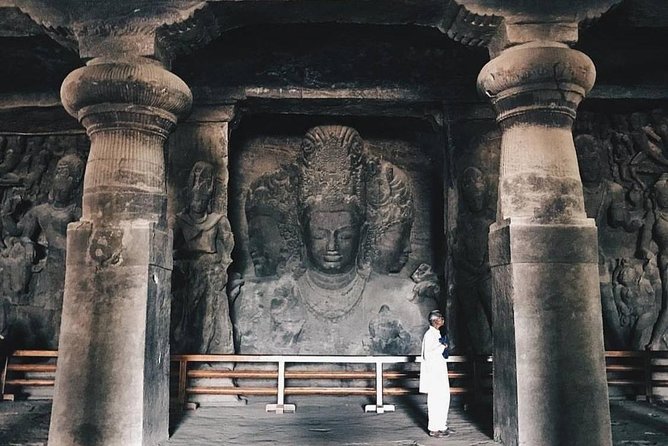
Cave 1 is the one everybody comes for. It is 39 metres deep, cut as a square floor plan with rows of heavy columns carrying the rock ceiling, gateways on three sides, and a sealed inner shrine housing a Shiva lingam. All four walls hold monumental bas-reliefs — roughly nine in total — each depicting a different manifestation of Shiva.
The carvings were hacked and disfigured by Portuguese soldiers in the 16th century, but enough survives that the skill of the 5th-century stonemasons still comes through.
The single most important sculpture is the Maheshmurti — a three-headed bust of Shiva cut into the back wall of the cave, nearly 6 metres tall. The three heads represent creation (right face, Vamadeva, the feminine), protection (centre face, Tatpurusha, the preserver), and destruction (left face, Aghora-Bhairava, the fierce). It is carved with such delicacy that the closed eyes and half-smile of the central face still read across 1,500 years.

The other eight major reliefs around the cave walls are worth lingering over.
From left to right they depict Shiva as the cosmic dancer (Nataraja), Shiva killing the demon Andhakasura, Shiva and Parvati on Mount Kailash, Ravana lifting Mount Kailash, the wedding of Shiva and Parvati (Kalyanasundaramurti), the descent of the Ganges (Gangadhara), Ardhanarishvara (half-Shiva half-Parvati), and Yogishvara (Shiva the meditating yogi).
A good guide will walk you through each one and explain the story — without that context the panels just look like weathered stone.

Caves 2 to 5
If you still have time and energy after Cave 1, walk the short path to Caves 2 and 3 on the same terrace. Cave 2 is unfinished and mostly empty. Cave 3 has a verandah with partial columns and a damaged Shiva linga. Caves 4 and 5 are higher up the hill and are essentially plain chambers with a few worn statues. Archaeologists believe all five caves were once painted in bright colours, but no pigment has survived.
The whole site is small enough that you can see everything in under two hours if you are moving briskly. Most visitors spend 90 minutes on top and use the rest of their half-day on the ferry crossings.

Costs: A Real Breakdown
Here is what you will actually spend doing Elephanta independently as a foreign visitor in 2026, in rupees. Convert roughly 83 rupees to $1 USD:
- Round-trip ferry from Gateway of India — 180 rupees ($2.20)
- Upper deck supplement (optional) — 10 rupees ($0.12)
- Island entry fee — 5 rupees ($0.06)
- Miniature train jetty to hill (optional) — 10 rupees ($0.12)
- UNESCO site entrance — 600 rupees ($7.20)
- Toilet at base of hill — 5 rupees ($0.06)
- Bottled water and snacks — 100 to 200 rupees ($1.20 to $2.40)
- Total DIY cost: roughly 950 rupees per person, or $11.50
A guided tour runs $30 to $42 per person depending on whether it is private and whether it includes hotel pickup. The extra roughly $20 buys you a real interpretation of the carvings (the on-site signage is almost non-existent), a guide who handles the ticket queues at the Gateway of India, and usually transport from your hotel to the ferry terminal and back.
We think it is worth it for first-time visitors — you miss the whole point of the caves without someone who can explain the iconography.
When to Go
The Elephanta Caves are open year-round Tuesday through Sunday, but Mumbai’s weather makes timing matter.

November to February is the sweet spot. Daytime highs sit in the mid-20s to low 30s Celsius, the humidity drops, the sky is usually clear, and the sea is calm. This is also peak tourist season, so expect larger crowds at the Gateway of India ferry queue — aim for the 9:00am or 9:30am departure to beat the rush.
March to May is increasingly hot. April and May are brutal — upper 30s with high humidity — and the 120-step climb becomes genuinely difficult by late morning. If you visit in this window, take the first ferry of the day and be back at the jetty before noon.
June to September is monsoon season, and this is the only time ferries actually stop running. The Mumbai Port Trust suspends Elephanta ferry services during heavy monsoon — usually mid-June through mid-September — because of rough seas in the harbour. Check the current status with your hotel or the ferry counter directly before planning a monsoon-season visit.
October is a good shoulder-season pick: ferries resume, temperatures drop, and tourist numbers have not yet spiked.
Elephanta and Your Wider India Itinerary

Elephanta is a half-day experience and pairs naturally with a second Mumbai activity for the same day. Most visitors we spoke to combined it with either a Dharavi slum tour in the morning, a Bollywood studio tour in the afternoon, or South Mumbai heritage walk covering the Gothic and Art Deco buildings around Colaba and Fort.
If Elephanta is part of a longer India trip, it fits best near the start or end of a Mumbai stop. A common 10-to-14 day North and West India itinerary we see looks like: Delhi (3 days, Old and New Delhi city tour, Old Delhi food walk), Agra day trip (Taj Mahal from Delhi), Jaipur (2 days, Jaipur city tour), fly to Mumbai (3 days including Mumbai sightseeing, Dharavi, and Elephanta), then Goa.
Where to Stay Near the Ferry

If you are serious about catching the first ferry out to Elephanta, sleep in Colaba or Fort. The Gateway of India is at the southern tip of the peninsula and the ferry terminal is literally at its base, which means a Colaba hotel puts you within a 10-minute walk of the dock. Two categories of option:
Luxury: The Taj Mahal Palace Hotel and the Taj Mahal Tower stand directly next to the Gateway — you can see the caves ferry from some of the harbour-view rooms. A close second is the Trident at Nariman Point, 15 minutes by taxi. Both are expensive but they are the only hotels within a short walk of the ferry.
Mid-range: Abode Bombay, Residency Hotel Fort, and Sea Palace Hotel all sit in Colaba within 5 to 10 minutes walking distance of the Gateway. All three are under $100 a night and have air conditioning, which is non-negotiable in Mumbai. If you are flexible on neighbourhood, Bandra is cooler and livelier but you will need to Uber down to Colaba the morning of your ferry — allow 45 to 60 minutes for traffic.
What to Pack
- Cash in rupees. Every fee on the island is cash only. Bring at least 1,000 rupees in small notes.
- A refillable water bottle inside a zipped bag. Not dangling from a hand (monkeys).
- Sturdy walking shoes. The stone steps and cave floors are uneven and often wet.
- A hat and sunscreen. The jetty and lower path are unshaded.
- A light jacket or scarf for the ferry deck — wind off the harbour is chilly even in warm weather.
- Phone with downloaded offline map of Gharapuri Island. Signal on the island is patchy.
- Hand sanitiser. The on-site toilet is basic.
Common Mistakes to Avoid
Going on a Monday. The caves are closed. The ferry still runs but you cannot enter the UNESCO site. We see people make this mistake every week — double-check the day before you go.
Missing the last ferry back. The final return boat from Gharapuri to the Gateway leaves around 5:30pm, sometimes earlier if it fills up. Be at the jetty by 4:30pm to be safe. There is no alternative way off the island.
Assuming you can pay by card. You cannot. Every transaction — ferry ticket, island entry, UNESCO fee, toilet, water — is cash rupees only. There are no ATMs on the island.
Trying to see all five caves thoroughly. Cave 1 is 90% of the experience. Caves 2 through 5 are worth a quick look but do not burn through your time and energy on them.
Skipping the guide. The bas-reliefs in Cave 1 look like abstract weathered stone to anyone who does not know Shaivite iconography. Without a guide you will walk around for 15 minutes and leave confused. Either book one of the tours above or hire an Archaeological Survey of India licensed guide at the Cave 1 entrance for around 300 to 500 rupees.

Food and Drink on the Island
There is exactly one small restaurant cluster on Gharapuri — at the base of the hill, just past the jetty. Options are basic: masala dosa, veg thali, fried rice, pakoras, packaged biscuits, bottled water, and fresh coconuts. Expect to pay 100 to 250 rupees per plate. The coconuts are the standout — 50 rupees for a chilled green one with a straw, and a lot better than plastic bottled water after the climb down.
Do not try to bring food up to the caves themselves. Apart from being disrespectful in an active UNESCO site, you will be mobbed by monkeys within 30 seconds. Eat at the base before the climb or after the descent.
Accessibility
Honest answer: Elephanta is not an accessible site. The ferry requires stepping across a gap between boat and jetty. The miniature train from jetty to hill is fine for limited mobility. But the 120-step climb has no handrails, no elevator, and no ramp alternative. The only way up for wheelchair users is the 1,200-rupee palanquin chair carried by four men, and even that has obvious ethical issues.
Inside Cave 1 the floor is uneven rock with significant level changes. If stair climbing is hard, Elephanta is probably not the site for you — consider the Hanging Gardens or Marine Drive as alternatives.

Final Thoughts
Elephanta is one of those sites that rewards preparation. Go on a Monday, go without a guide, go unprepared for the monkeys — and you leave confused and mildly annoyed. Go on a Tuesday morning with a knowledgeable guide, a zipped bag of water, the right shoes, and a pocketful of small rupee notes — and the Maheshmurti Shiva carving will stay with you for the rest of your life.
The detail on the central face of that sculpture, carved 1,500 years ago into living basalt by craftsmen whose names we will never know, is genuinely one of the great pieces of sacred art in Asia.
For most first-time visitors, booking one of the three guided tours above is the right call. It handles the ferry ticketing, the on-site interpretation, and the transfers from your Mumbai hotel — and at $30 to $42 per person it is some of the best value guided experience in South Asia. Check current availability with the operators directly, confirm your date is not a Monday or in the mid-June-to-mid-September monsoon window, and bring plenty of cash.